

The Window Parents Don’t Know They’re Missing
If your child is between 7 and 10 years old, there’s a window of opportunity in their jaw and facial development that most parents don’t realize exists — and once it closes, it doesn’t reopen.
As an orthodontist, one of the most important conversations I have with parents is this: early orthodontic evaluation is not about rushing treatment. It’s about catching the right problems at the right time — when bones are still moldable, habits can still be redirected, and growth can still be guided.
I see children every week whose treatment would have been simpler — and in some cases, surgery could have been avoided entirely — if their parents had known what to look for just a few years earlier.
— Dr. Singh, Sing Orthodontics
The American Association of Orthodontists recommends a first orthodontic screening by age 7. This post will walk you through 13 specific signs that your child may benefit from early care — and explain why timing matters for each one.
What Is Early Orthodontic Care (Phase 1)?
Phase 1 orthodontic treatment — also called interceptive orthodontics — typically happens between ages 7 and 10, while children still have a mix of baby and adult teeth.
This is not the same as traditional braces. Phase 1 is orthopedic guidance: working with your child’s natural growth to correct jaw relationships, create space, and address habits before they become structural problems.
Think of it this way: A young tree can be guided with minimal effort. Once it’s fully grown, correction requires far more intervention — and sometimes, the shape is permanent.
The 13 Signs: What to Watch For
Jaw & Bite Development
The bite shifts to one side when closing
When your child bites down, does the lower jaw slide sideways at the last moment? This is called a posterior crossbite with a functional shift — one of the most time-sensitive issues in early orthodontics. The upper jaw is too narrow and the body compensates. Left untreated, the face can grow asymmetrically.
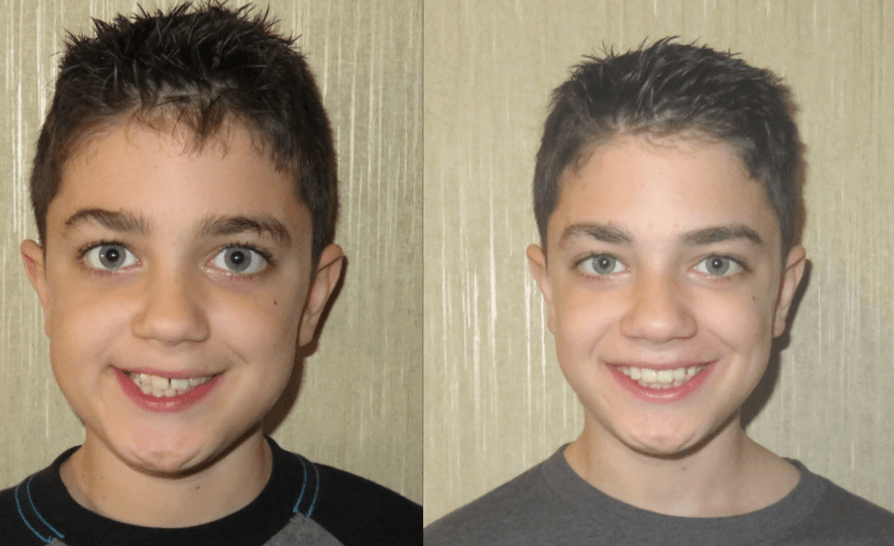
The lower jaw sits in front of the upper jaw
This is an underbite — and true skeletal underbites rarely self-correct. Between ages 7–10, the upper jaw can still be guided forward. After growth is complete, surgical correction may be the only option.
The upper front teeth stick out significantly (overjet)
Prominent upper front teeth carry a significantly higher risk of trauma. They often reflect a jaw size imbalance. Growth guidance can improve both aesthetics and function.
The top teeth completely cover the bottom teeth (deep bite)
When you can barely see the lower front teeth, that’s a deep bite. Over time, this causes excessive wear on enamel — which cannot regenerate — and can lead to jaw tension.
There isn’t enough space for incoming adult teeth
If baby teeth look crowded or adult teeth are visibly twisting as they come in, the arches may not be developing wide enough. During growth, arch width can be increased predictably. After growth, space issues often require extractions.
Tooth Position & Eruption
One front tooth is stuck behind the others
A single upper front tooth behind the lower teeth forces the lower jaw to shift forward on every bite. Over time this can contribute to gum recession and encourage an underbite pattern. It’s one of the most predictable corrections in early orthodontics.
An adult tooth hasn’t come in and should have
If the matching tooth on the opposite side erupted more than six months ago and the other hasn’t appeared, it’s time for evaluation. Catching this early can prevent full impaction, which requires surgical exposure.
X-rays show a tooth growing at the wrong angle
Dental x-rays around ages 7–9 can reveal developing teeth growing toward neighboring roots. Caught early, simple space creation or strategic removal of a baby tooth can redirect the path.
An extra tooth is blocking another tooth (supernumerary)
Some children develop an extra tooth, most often between the upper front teeth. These can block normal eruption and redirect permanent teeth. Early detection through routine x-rays allows for coordinated removal.
The arches look narrow or crowded
Narrow-looking smiles, crowded baby teeth, or overlapping adult teeth all signal that the arches may not be growing wide enough — often linked to mouth breathing and low tongue posture.
Habits & Function
Thumb or pacifier habit continued past age 4 (open bite)
Repeated pressure from sucking habits physically reshapes bone. The result is often an open bite. Before age 6, the bite often has a reasonable chance of self-correction once the habit stops.
The front teeth don’t touch when biting (tongue thrust)
If the front teeth don’t meet and the tongue pushes forward during swallowing, that’s tongue thrust. Swallowing happens thousands of times per day. Early myofunctional therapy combined with orthodontic care corrects both the teeth and the function.
The child primarily breathes through their mouth
Mouth breathing keeps the tongue low in the mouth rather than resting against the palate — and it’s the tongue’s resting pressure that drives upper jaw width. When children breathe through their mouths habitually, the upper jaw narrows, the face grows longer, and crowding increases.
Gum & Structural Signs
Gums pulling away from a tooth
Gum recession in a child is not normal. It usually means a tooth has erupted outside of its ideal bone support — often related to a crossbite or misaligned bite.
Front teeth that seem at risk of injury
Significantly protruding front teeth are vulnerable to playground accidents, sports impacts, and everyday falls. Reducing overjet during growth is one of the most straightforward injury-prevention strategies in orthodontics.
Why Timing Changes Everything
Between ages 7 and 10, a child’s jaw bones are still moldable. Orthopedic appliances can guide growth in directions that become impossible once the bones mature and sutures fuse.
What Changes With Age
| During Growth (Ages 7–10) | After Growth Is Complete |
|---|---|
| Jaw bones are moldable | Bones are fused and rigid |
| Facial growth can be guided | Facial patterns are established |
| Expansion works with biology | Expansion may require surgery |
| Crossbites correct with appliances | May require jaw surgery |
| Habits can still be redirected | Compensations become permanent |
| Phase 1 treatment is possible | Extractions may be needed |
I tell parents: we are guiding a growing face to have balance and harmony of its parts — the jaw size and position, and the bone that houses the teeth. Those are two very different things, and they require very different timing.
— Dr. Singh, Sing Orthodontics
What an Early Evaluation at Sing Orthodontics Looks Like
A growth assessment at our Austin, Round Rock & Lakeway practice is warm, caring and informative — whether or not your child ends up needing any treatment at all.
- Review dental and medical history
- Examine bite relationships, jaw alignment, and arch development
- Assess functional habits: mouth breathing, thumb sucking, tongue posture
- Review existing x-rays or take new ones if needed
- Walk you through findings in plain language
- Give a clear recommendation: monitor, treat now, or return at a specific age
Important: Not every child needs Phase 1 treatment. But every child deserves the right timing for healthy growth.
Frequently Asked Questions
At what age should my child first see an orthodontist?
The American Association of Orthodontists recommends a first evaluation by age 7. At this age, dysfunctional growth patterns can be identified and predictably treated with efficiency and ease of experience for the family.
Does early care mean my child will definitely need braces later?
Phase 1 addresses specific structural or functional problems early. Many children still benefit from Phase 2 braces in their teens. Phase 1 addresses growth and structural problems that lead to healthy growth — and in some cases prevent extractions or surgery.
What if we just wait and watch?
For some conditions, watchful waiting is exactly right — and we’ll tell you when that’s the case. But for others, waiting closes the window for simpler correction. Crossbites with jaw shifts, underbites, open bites from habits, and unerupted teeth all carry real risks when left unaddressed.
Explore the Full Early Care Series
- Does Your Child’s Bite Shift to One Side?Posterior Crossbite
- One Front Tooth Behind the OthersSingle Tooth Front Crossbite
- Lower Jaw in Front of the UpperUnderbite
- Top Teeth Completely Cover the BottomDeep Bite
- Upper Front Teeth Stick OutOverjet
- Front Teeth Don’t Touch (Habit-Related)Open Bite
- Tongue Pushing Between TeethOpen Bite / Tongue Thrust
- Child Breathes Through Their MouthMouth Breathing & Airway
- Gums Pulling Away From a ToothGum Recession in Children
- Adult Tooth Not Coming InUnerupted Permanent Tooth
- Extra Tooth Blocking AnotherSupernumerary Tooth
Growth Is Opportunity
The earlier we evaluate, the more options your child has.